
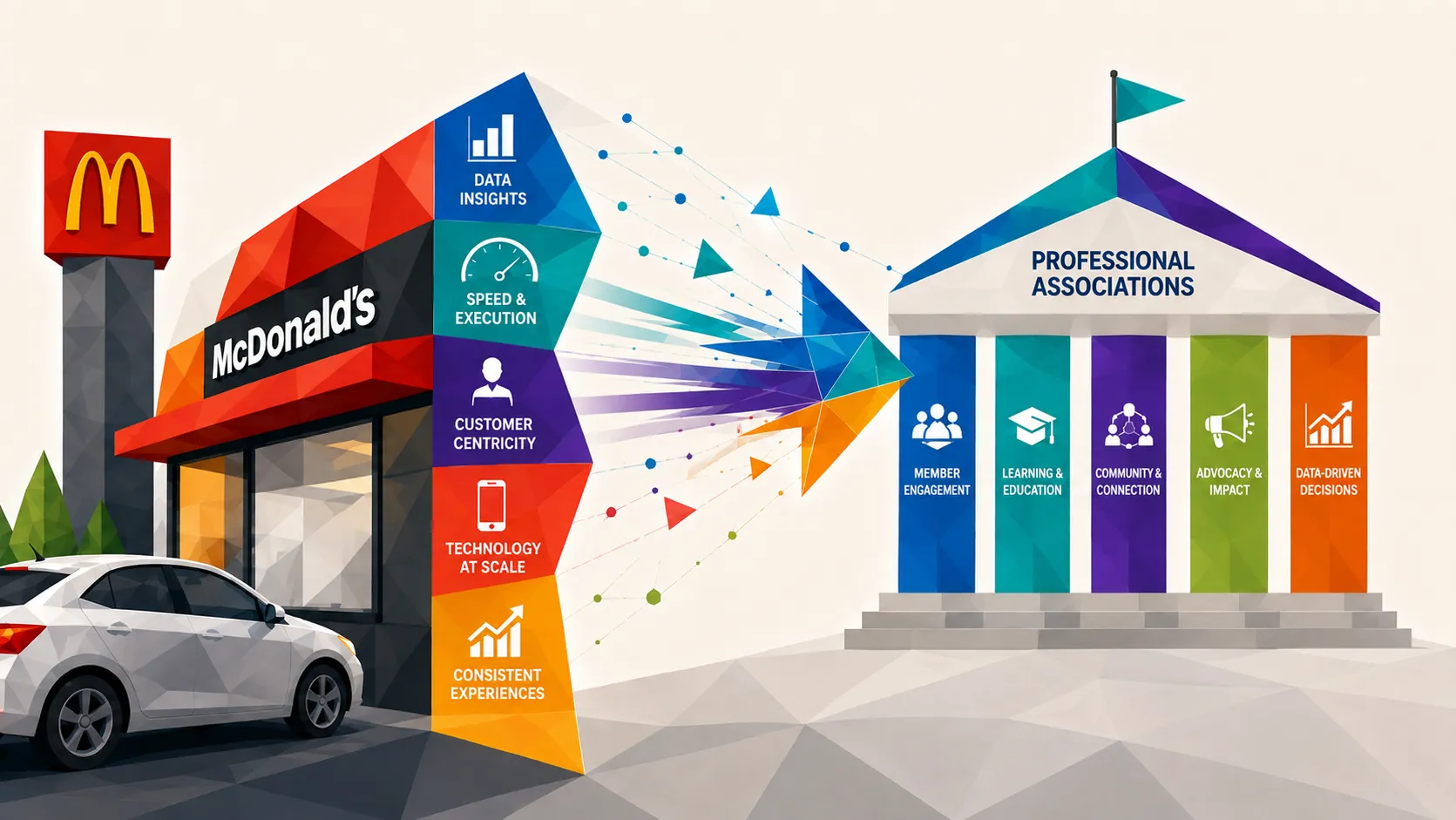
Professional associations are not struggling because their missions are unimportant. They are struggling because expectations have changed. Across healthcare and other professions, associations face a widening relevance gap the distance between traditional offerings and the lived realities of modern professionals.
Meetings.
Dues.
Journal subscriptions.
Industry sponsorship.
These long-standing economic pillars are under sustained pressure. This is not a cyclical downturn.
It is structural.
And surprisingly, one of the clearest case studies for navigating this transition comes not from academia but from fast food.
Hamburger Economics: When Legacy Meets Expectation Shift
A few years ago, McDonald’s faced challenges that mirror those of many professional associations:
- An aging core audience
- More nimble competitors
- Lagging technology infrastructure
- Underutilized customer data
- Slowing revenue growth
Former CEO Don Thompson admitted the company had failed to:
“Evolve at the same rate as our customers’ expectations.”
That sentence could be applied to many associations today. The issue was not hamburgers. It was pace.
How McDonald’s Responded
Under new leadership, McDonald’s didn’t start by reinventing the Big Mac.
They invested in infrastructure.
They acquired AI startups.
They invested in data analytics.
They implemented voice recognition.
They personalized menu recommendations.
They reimagined store layouts.
They treated each location as a data engine learning from behavior, predicting intent, and optimizing experience. Most importantly, they embraced a core truth of the modern economy:
Speed matters more than size.
As CEO Steve Easterbrook said:
“In old-school business logic, the big eats the small. In the modern-day, the fast eats the slow.” This principle now applies to associations.
The Parallel: Professional Associations in 2026
Professional associations face similar headwinds:
- Younger professionals questioning membership value
- Information accessible instantly through AI tools
- Digital-native competitors
- Increased expectations around personalization
- Limited time for engagement
Members no longer compare your experience only to other associations.
They compare it to:
- Netflix personalization
- Amazon recommendations
- AI-powered search
- Seamless digital learning
If your digital experience feels static, friction emerges.
The Data Imperative: Associations as Knowledge Engines
McDonald’s viewed every store as a data source. Associations should view every interaction as insight. Your organization holds valuable data:
- Member behavior
- Learning patterns
- Abstract submissions
- Conference attendance
- Certification pathways
- Engagement touchpoints
Yet many associations:
- Do not aggregate this data
- Do not analyze it meaningfully
- Do not personalize based on it
Modern infrastructure enables:
- Personalized learning paths
- Targeted communications
- Behavior-informed renewal campaigns
- Smarter event design
- Predictive member retention strategies
Data is not about surveillance.
It is about relevance.
Reinventing the Meeting Experience
McDonald’s launched “Experience of the Future” experimental environments to test improved customer journeys. Associations should do the same. In a world where:
- Content is on-demand
- Sessions are recorded
- Webinars are constant
Why should members travel? The answer is not tradition. It is experience. Forward-looking associations are reimagining meetings through:
- Curated networking
- Interactive formats
- Data-informed scheduling
- Personalized agendas
- Hybrid integration
- AI-enhanced session discovery
Meetings must become experiential not just informational.
AI: The Accelerant
The original version of this analogy focused on analytics. In 2026, AI is the multiplier.
Members now expect:
- Intelligent search across journals
- Real-time guideline summaries
- Personalized CME recommendations
- Context-aware knowledge tools
If associations do not explore responsible AI integration, commercial platforms will fill the gap. The opportunity is not to chase trends.
It is to unlock your curated, peer-reviewed content intelligently.
Culture: The Hidden Multiplier
Technology investments fail without cultural evolution. Associations must foster:
- Risk tolerance
- Cross-functional collaboration
- Innovation funding
- Executive alignment
- Digital literacy
Innovation cannot be episodic. It must be structural.
Executive Questions for Association Leaders
1
Are we evolving at the pace of our members?
2
Are we using our data strategically?
3
Is our infrastructure enabling personalization?
4
Have we reimagined our meeting experience?
5
Do we have a defined AI strategy?
6
Are we culturally prepared to experiment?
If the answers are unclear, the relevance gap widens.
The Strategic Shift
The lesson from McDonald’s is not about hamburgers. It is about adaptation.
Mature institutions that survive disruption:
- Invest in infrastructure
- Leverage data intelligently
- Personalize experiences
- Experiment with format
- Move faster than their competitors
Associations that rely solely on legacy strength will struggle. Those that modernize thoughtfully will lead.
The Bottom Line
In the past, size conferred advantage. Today, agility does. Professional associations possess:
- Trusted brands
- Deep expertise
- Loyal communities
Those are powerful assets. But without modernization without speed even powerful brands lose relevance. The future will not belong to the largest associations.
It will belong to the fastest learners.