
Association
Society for Scholarly Publishing (SSP)
Reimagining a Complex Digital Ecosystem Around Community, Discovery & Connection
Strategic Partner for 1+ Years

Background
The Society for Scholarly Publishing (SSP) is a nonprofit professional society connecting more than 1,000 professionals across publishing, research, technology, libraries, scholarly societies, and the broader scholarly communications ecosystem. Its digital presence extends well beyond SSPnet.org to include The Scholarly Kitchen, its OnDemand Library, C³ community, career resources, publications, events, and member services.
SSP needed more than a visual website refresh. It needed a digital experience that could make this broad ecosystem easier to understand, navigate, manage, and discover while better communicating the value of SSP to both long-standing members and people encountering the organization for the first time.
The Challenge
SSP had an incredibly rich collection of programs, content, communities, and resources, but that depth also created complexity.
Discovery identified several opportunities:
- Make SSP’s value immediately understandable to new and prospective members
- Simplify navigation across a large and interconnected digital ecosystem
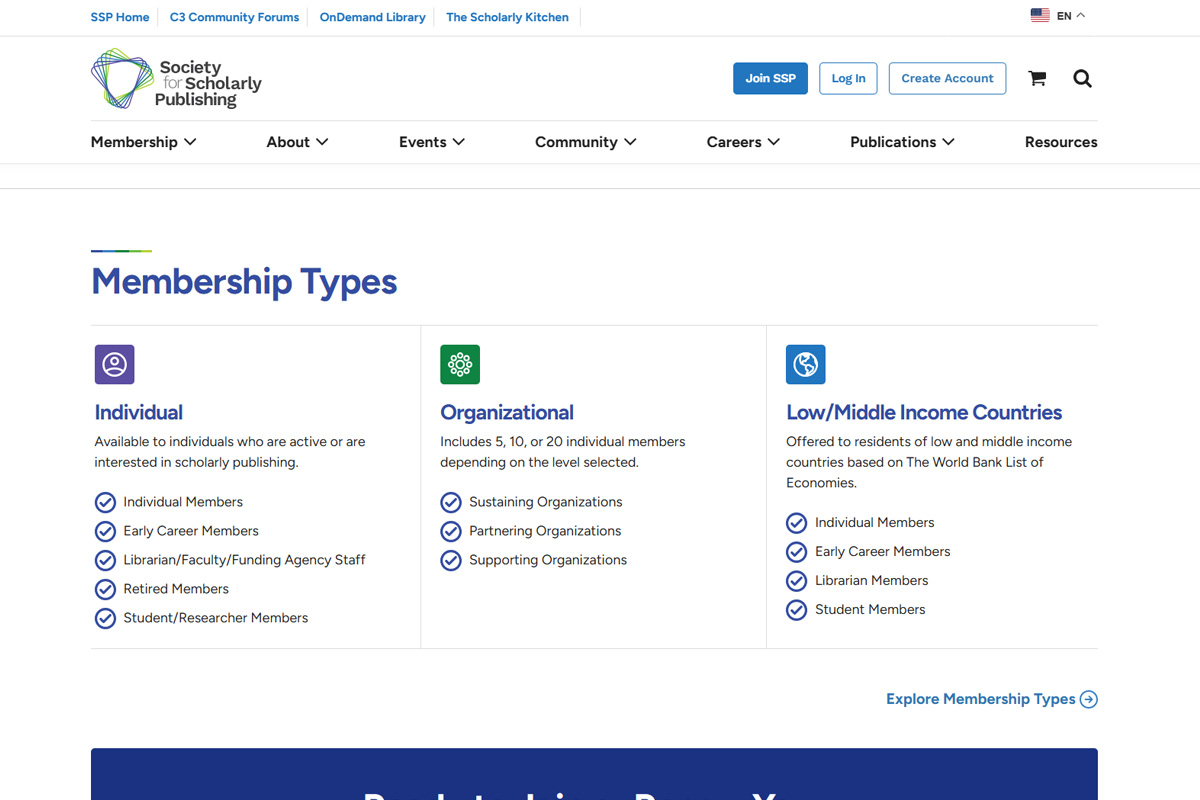
- Create clearer pathways to membership, events, community, careers, and resources
- Reduce insider terminology and make content more accessible to users at different career stages
- Modernize content structure without losing valuable institutional knowledge
- Improve search visibility and prepare content for AI-driven discovery
- Integrate multiple third-party systems without creating a fragmented user experience
- Give SSP staff a flexible, sustainable WordPress editing experience
The challenge was not simply to reorganize a website. It was to make the breadth of SSP feel like a strength rather than complexity.

Discovery & Audience Strategy
Discovery Driven by People and Data
Celerate began with a comprehensive discovery process combining stakeholder input with quantitative and behavioral data. We interviewed SSP leadership, staff, members, volunteers, and stakeholders to understand how different audiences experience the organization and what they need from the website.
Those insights were combined with:

Google Analytics and Search Console data
Microsoft Clarity behavioral analysis
Content inventory and migration analysis
Accessibility review
SEO and AEO analysis
Competitive benchmarking
Audience and user-story mapping
Existing taxonomy and content structure review
Rather than designing around SSP’s internal organizational structure, we focused on what users are actually trying to accomplish.
A Dual-Lens Audience Strategy
SSP serves an unusually diverse professional community. Our audience research identified two complementary ways to understand its users.
By organization: publishing companies, service providers and vendors, scholarly societies, universities and libraries, research institutions, funders and policy stakeholders.
By role: executive leadership, senior and mid-level management, professional and technical specialists, administrative/support professionals, and students.
This helped us design an experience that recognizes both where someone works and what they are trying to accomplish.
Designing Around User Intent
Across SSP’s diverse audiences, we identified five recurring user intentions:
Discover. Engage. Learn. Connect. Manage.
These intentions became a foundation for the site’s information architecture and user experience.
Instead of expecting visitors to understand SSP’s internal structure, the new experience creates clearer pathways to:
- Understand SSP and the value of membership
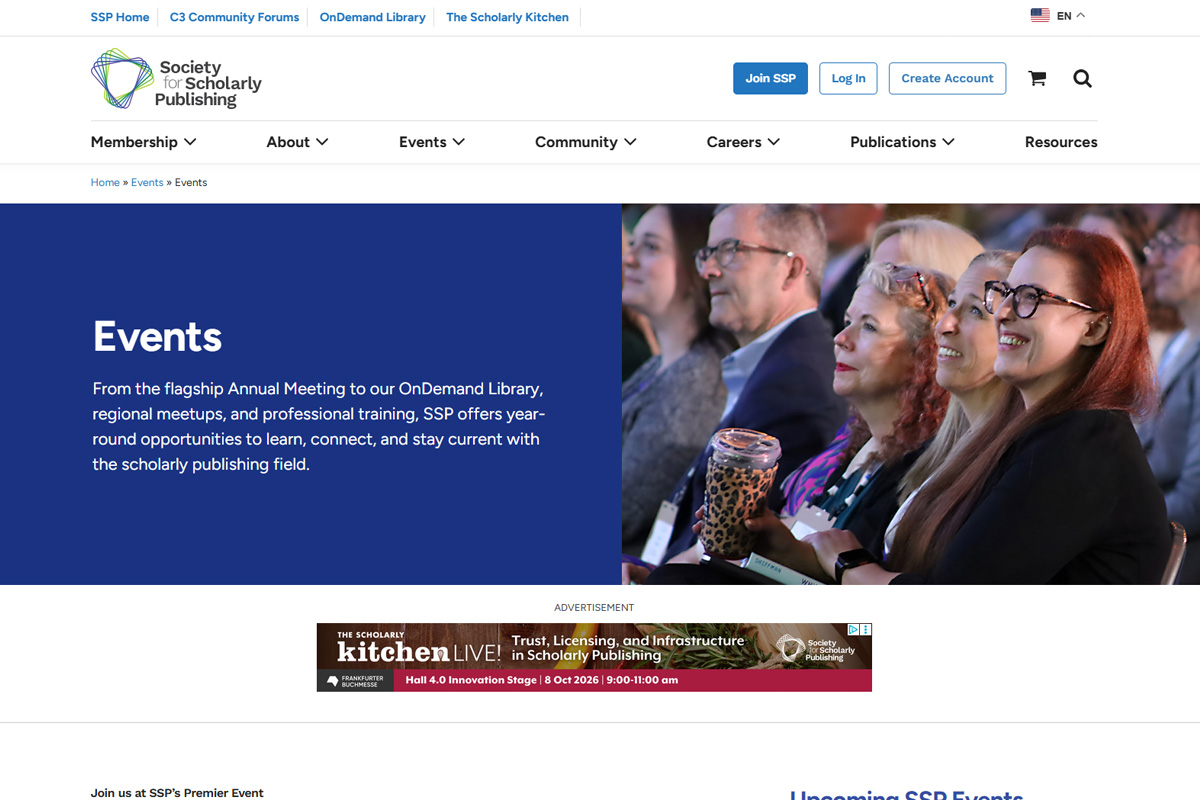
- Discover events and professional development
- Access resources and thought leadership
- Participate in the SSP community
- Find career development opportunities
- Complete member and administrative tasks
Experience & Information Architecture
A New Information Architecture
The redesign reorganized SSPnet.org around major user needs while preserving the depth of the organization’s content.
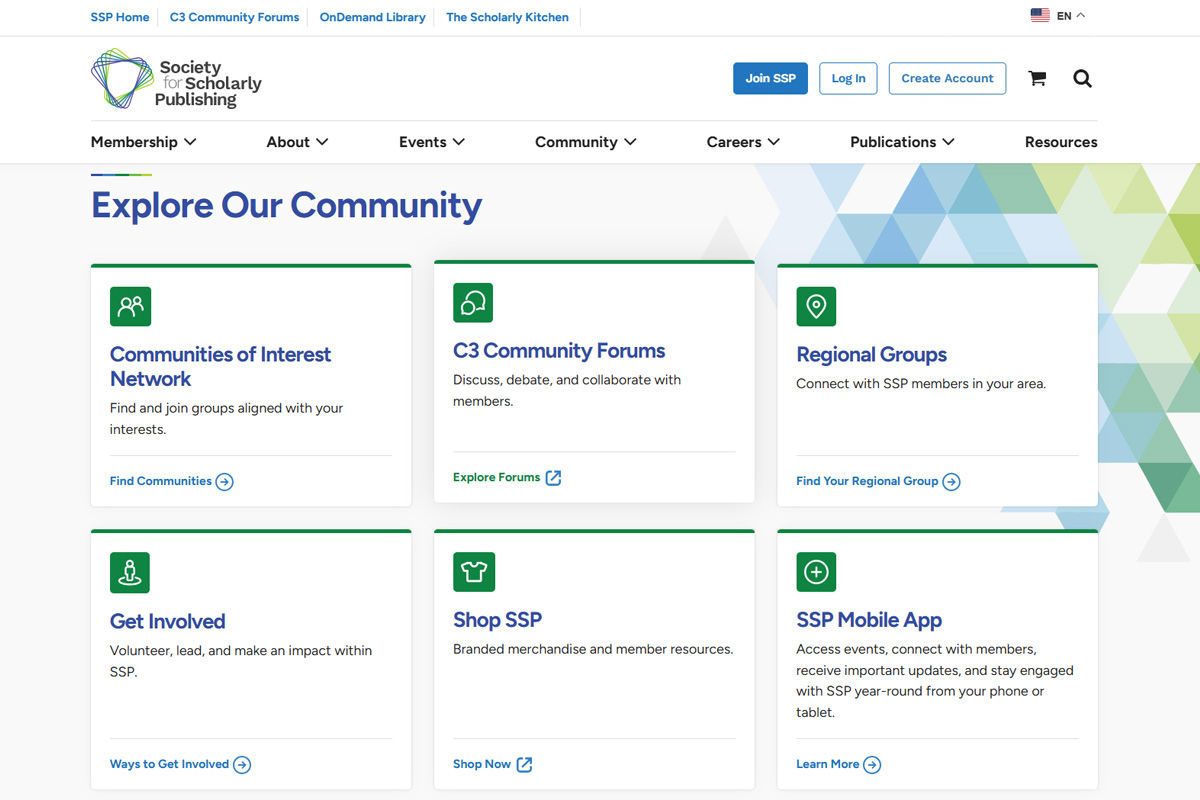
The new architecture establishes clear hubs for Membership, Events, Community, Careers, Publications, Resources, and About SSP, with contextual pathways into SSP’s broader ecosystem. The live site now connects users directly to services including C³ Community Forums, the OnDemand Library, The Scholarly Kitchen, the member portal, career center, and other SSP resources.
Mega navigation, stronger landing pages, related-content pathways, and clearer calls to action help users understand both where they are and where they can go next.
Bringing SSP’s Community Forward
One of the strongest findings from Discovery was that SSP’s greatest asset isn’t simply its content it’s its community.
The redesign makes that community more visible throughout the experience through member profiles, networking pathways, C³ integration, career development, events, and opportunities to get involved.
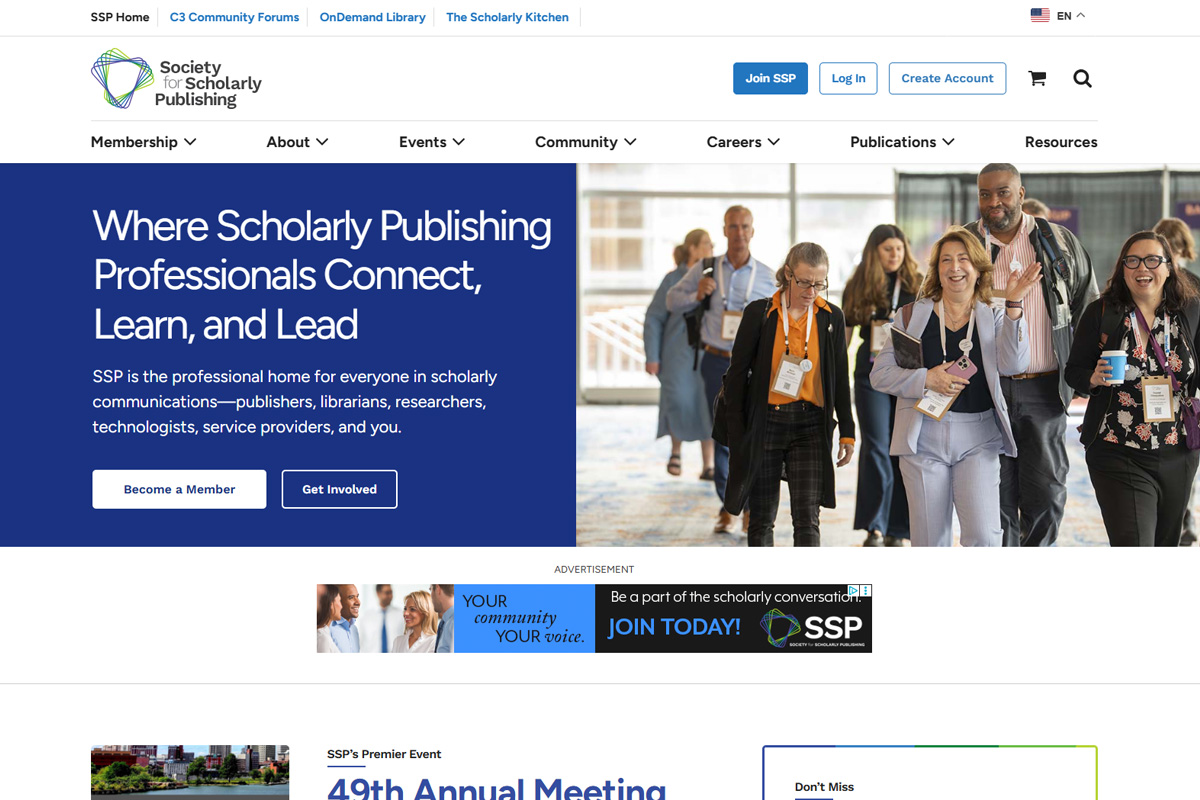
The homepage now communicates SSP as a professional home for the scholarly communications community while highlighting its global network, career development opportunities, events, networking, and year-round engagement.
Connecting a Complex Technology Ecosystem
SSPnet.org is the front door to a much larger technology ecosystem. Celerate designed the WordPress experience to work across existing platforms and integrations. Our philosophy was simple: the user shouldn’t have to understand which system is powering an experience. The website provides the connective layer that makes SSP’s broader ecosystem feel intentional and cohesive.
Taxonomy as Infrastructure
For SSP, taxonomy isn’t simply a collection of tags. It plays an important role in how users discover content across a large scholarly publishing knowledge base.
Celerate worked with SSP’s existing controlled vocabulary and taxonomy approach to plan for consistent classification, editorial control, improved filtering, and stronger content discovery.
This creates a foundation not only for traditional site search, but also for future personalization, related-content experiences, and AI-powered discovery.
SEO + AEO Built Into the Redesign
Search strategy was incorporated into the redesign from the beginning rather than added after development.
Celerate reviewed content structure, metadata, search intent, schema, redirects, internal linking, and high-value landing pages to improve traditional organic search performance.
We also considered how SSP’s authoritative content can be understood and cited by AI-driven answer engines.
The strategy included:
Search-intent-driven page titles and metadata
Improved heading and content structure
Structured data and schema
Canonical URL planning
Redirect strategy for migrated and retired content
Hub-and-spoke internal linking
Clear question-and-answer content patterns
Taxonomy-driven content relationships
AI-readable descriptions of SSP, its programs, and its expertise
The objective was to make SSP’s expertise easier for people, search engines, and emerging AI platforms to understand.

A Flexible WordPress Experience for Staff
The new site was built around native WordPress capabilities and Celerate’s GoSuite WordPress framework, minimizing unnecessary plugin dependencies and avoiding proprietary lock-in.
Reusable components and structured content models give SSP staff the flexibility to create and maintain pages while preserving design consistency, accessibility, and responsive behavior.
Role and workflow-based training helps staff learn the tasks they actually perform rather than requiring them to navigate a large generic CMS manual.

Accessibility by Design
Accessibility was incorporated throughout strategy, design, development, content migration, and QA.
The site was designed toward WCAG 2.2 AA, with attention to:
- Semantic page structure
- Keyboard navigation
- Heading hierarchy
- Color contrast
- Alternative text
- Form usability
- Link clarity
- Responsive/mobile behavior
Accessibility was treated as part of the user experience not a post-launch checklist.
The Transformation
The new SSPnet.org creates a stronger digital foundation for an organization that sits at the center of a rapidly changing industry.

A clearer digital front door
Visitors can understand what SSP is, why it matters, and where they belong more quickly.

A connected ecosystem
Membership, community, events, careers, publications, learning, and resources are presented as parts of one SSP experience even when powered by different platforms.

Community brought to the forefront
Member stories, networking, C³, professional development, and opportunities to participate reinforce the human connections at the heart of SSP.

Stronger content discovery
Improved IA, taxonomy, search, filtering, and related-content pathways make SSP’s extensive knowledge base easier to explore.

Search and AI readiness
SEO, structured content, schema, taxonomy, and AEO principles establish a stronger foundation for how SSP is discovered through both traditional search and emerging AI experiences.

A platform built to evolve
Reusable WordPress components and a core-aligned development approach give SSP a flexible foundation that can grow alongside the organization.
Key Takeaways
1
Complex ecosystems should feel simple.
Users shouldn’t need to know which platform powers membership, community, video, careers, or events. The website should connect those experiences for them.
2
Design around intent not organizational charts.
Understanding what people are trying to accomplish creates stronger navigation than mirroring an organization’s internal structure.
3
Community is content.
For a professional society like SSP, people, connections, mentoring, events, and participation are as important to the digital experience as articles and resources.
4
Taxonomy is strategic infrastructure.
A well-structured taxonomy improves navigation today while creating the foundation for search, personalization, related content, and AI tomorrow.
5
SEO begins with architecture.
Search performance isn’t just metadata. IA, content quality, terminology, internal linking, accessibility, schema, and user behavior all contribute to discoverability.
Ready to build something that matters?
Let’s talk. We’d love to hear what you’re working on.
(Call us at 301-694-0273 or email us at hello@goclerate.com)