
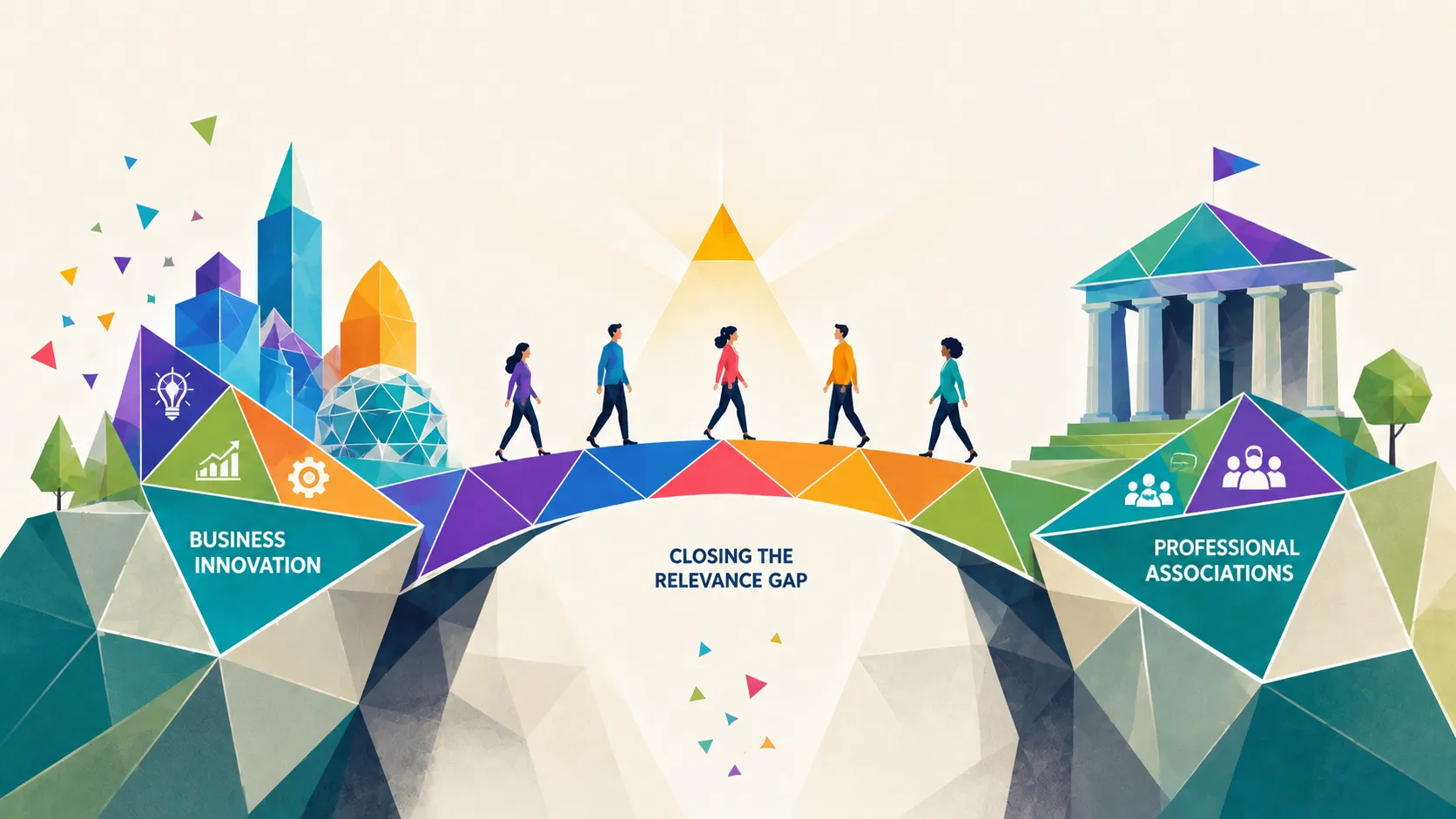
Professional associations are not in decline.
They are in transition.
Across sectors especially healthcare, engineering, legal, and technical professions associations are confronting what can only be described as a relevance gap.
Traditional offerings annual meetings, journal subscriptions, static education, member dues are no longer sufficient on their own. Members expect:
- On-demand access
- Real-time knowledge
- Personalized learning
- Digital-first experiences
- Measurable career advancement
When expectations evolve faster than institutions, affinity erodes. And when affinity erodes, revenue pillars weaken. This is not a temporary disruption. It is structural.
The Relevance Gap: Why It’s Growing
The modern professional operates in a radically different environment than even five years ago.
They face:
- Information overload
- Rapid technological change
- Workforce shifts
- Increased credentialing pressure
- AI-enabled knowledge tools
In many cases, members can now access:
- Peer networks through LinkedIn or Slack
- Education through independent platforms
- Research through open-access tools
- AI-driven knowledge summaries instantly
If associations do not evolve at the same rate as member expectations, members will quietly disengage. The challenge is not competition from other associations.
It’s competition from everywhere.
Three Strategic Imperatives for Association Renewal
Innovation cannot be accidental. It must be intentional, structured, and resourced.
1
Create a Shared Sense of Urgency
Legacy is an asset but it can become inertia. Boards and executive teams must confront hard questions:
- Are our core offerings still indispensable?
- Are younger professionals engaging differently?
- Are we measuring member behavior accurately?
- Is our technology infrastructure modern?
Without urgency, innovation stalls. The goal is not panic it’s clarity.
2
Build a Resilient, Risk-Tolerant Culture
Associations are often consensus-driven and committee-oriented. That governance structure provides stability but it can slow experimentation. To close the relevance gap, associations must normalize:
- Pilots
- Prototypes
- Short innovation cycles
- Data-informed iteration
Innovation is not about abandoning tradition. It’s about testing new value propositions while preserving core mission. Leaders must make it safe to experiment and safe to fail.
3
Institutionalize Innovation
Innovation cannot depend on one visionary staff member. It must be embedded structurally.
That means:
- Allocating a defined innovation budget
- Including innovation goals in performance reviews
- Creating cross-functional innovation teams
- Establishing metrics for experimentation
Associations that treat innovation as extracurricular rarely sustain it. Those that operationalize it make progress.
AI and Digital Acceleration: A New Layer of Pressure
While the relevance gap predates artificial intelligence, AI has accelerated it.
Members are now asking:
- Why can’t I search my association’s knowledge base like I search ChatGPT?
- Why isn’t continuing education personalized?
- Why does accessing research feel slow?
- Why can’t I get immediate answers to clinical or technical questions?
AI is not the strategy. But it is reshaping expectations around:
- Speed
- Personalization
- Accessibility
- Responsiveness
Associations that ignore this shift risk appearing outdated even if their content remains exceptional. The question is not “Should we use AI?”
The question is:
How do we integrate emerging tools responsibly while protecting credibility and trust?
Practical Innovation Tactics Associations Can Implement Now
Here are realistic, scalable actions associations can take.
Launch an Organization-Wide Innovation Challenge
Set aside a modest innovation fund.
Invite staff across departments to propose:
- New digital offerings
- Member engagement models
- Technology enhancements
- Revenue experiments
Reward selected ideas with implementation resources and recognition.
Innovation often exists quietly within teams it simply needs permission.
Establish Innovation Ambassadors
Create a cross-divisional team responsible for:
- Monitoring industry shifts
- Exploring partnership opportunities
- Evaluating emerging technologies
- Prototyping new programs
Give them time, mandate, and visibility. Without formal ownership, innovation becomes optional.
Modernize Member Experience Infrastructure
Innovation is cultural but it’s also technical.
Associations should evaluate:
- Member management systems
- Learning platforms
- Abstract and meeting tools
- Data integration capabilities
- Analytics dashboards
Legacy systems often constrain innovation more than culture does. Infrastructure determines agility.
Partner Beyond Your Industry
Consider collaboration with:
- Technology incubators
- University research labs
- Startups aligned with your field
- Cross-disciplinary organizations
Exposure to entrepreneurial thinking reshapes internal mindset. Associations do not need to become startups but they must understand how startups operate.
Leadership: The Most Important Variable
Senior leaders must anticipate resistance.
Innovation:
- Disrupts workflows
- Raises uncertainty
- Challenges historical revenue streams
- Forces uncomfortable conversations
Empathy is essential. So is clarity. Leaders must communicate:
- Why change is necessary
- What will remain constant
- What is being protected
- What is being reimagined
Professional development, coaching, and open dialogue are critical. Innovation fails when culture feels threatened.
Executive Questions to Ask Now
Boards and executive directors should regularly evaluate:
1
Are we evolving at the pace of our members?
2
Where are we losing engagement?
3
Are we measuring member behavior in real time?
4
Is innovation funded or just encouraged?
5
Does our technology enable or limit experimentation?
If those answers are unclear, the relevance gap widens.
Frequently Asked Questions
Why are professional associations losing relevance?
Because member expectations around speed, personalization, and digital access have evolved faster than traditional offerings.
How can associations foster innovation?
By creating urgency, funding experimentation, building cross-functional teams, and modernizing infrastructure.
Should associations adopt AI?
AI should be evaluated as part of a broader digital strategy, focused on improving member access and experience while preserving trust.
What is the biggest barrier to innovation in associations?
Cultural inertia combined with legacy technology systems.
The Strategic Opportunity
The relevance gap is not a verdict.
It is a signal.
Associations possess:
- Trusted brands
- Deep subject matter expertise
- Established communities
- Institutional memory
Those assets are powerful but only when paired with agility.
The future of professional associations will not be decided by tradition alone.
It will be shaped by leaders willing to:
- Recognize change
- Invest in innovation
- Modernize infrastructure
- Empower their teams
The associations that thrive in current times will not abandon their legacy.
They will evolve it.